LOBAKA Sasa · Algiers

Your audience listens in its own language, on its own phone.

One room, several audio channels, everyone in their own language. The audience scans a QR code, picks a channel and listens through their earphones. No app, no account, no receivers to hand out.

Already in an equipped room? Join a session →

One room · four channelsLive
Room audioOriginal

Live commentaryCommentary@mbongo

EnglishTranslation@lina_en

Audio descriptionAudio desc.@sery

4 channels · 1 roomNo receivers

Four people side by side, four different things in their ears. That's LOBAKA Sasa.

The problem

Language shouldn't decide who gets to take part.

Someone attends a conference, a service, a museum tour, a congress. The room speaks a language they don't understand. They miss what is happening, or they switch off.

The classic answer exists: interpretation booths, individual receivers to hand out and collect, dedicated technicians. It works, but it is expensive, it takes staff, and it stays reserved for large venues. Most events do without it — and leave part of the audience behind.

The solution

LOBAKA Sasa turns every smartphone into a receiver.

LOBAKA Sasa is a multichannel audio distribution infrastructure for multilingual rooms. The organizer creates a session and its channels; the speakers — interpreters, commentators, guides — each talk on their own; the audience scans a QR code, picks a channel and listens through their own earphones.

Nothing to hand out, no accounts to create, no receivers to collect at the end of the night. A room, a connection, and the phones people already carry.

LOBAKA Sasa · How it works

A QR code, a phone, a channel.

No receivers to hand out, no app to install, no account for participants. The organizer prepares the session; each speaker talks on their own channel; the audience scans and listens.

01

The organizer

Open a session on LOBAKA Sasa, create the channels you need — commentary, translation, audio description — and display the QR code on a screen or sign. No registration required for attendees.

02

The voices

Each voice — commentator, translator, describer — speaks on their channel from a phone or the venue's mic.

03

The listeners

They scan the code, choose their channel, and listen through their earphones. The stream is continuous and live. They can switch channels at any time.

Earphones required — wired or Bluetooth, the ones everyone already owns.

Wi-Fi or mobile data connection needed in the venue.

Expect about 30 MB of data per hour of listening (compressed voice, with loss protection).

The roles

Organizer, speakers, participants.

LOBAKA Sasa involves three parties: the person who organizes, those who speak, and the audience that listens. Here is what each one does, and what they see on their screen — in the words of the app.

01

The organizer

You, or whoever prepares the event.

What they do

  • Creates the session, names the event, adds one channel per language or audio experience.
  • Invites each speaker with a personal link, and gives or takes back the floor on a channel.
  • Projects the QR code in the room and follows, live, how many people listen to each channel.

What they see

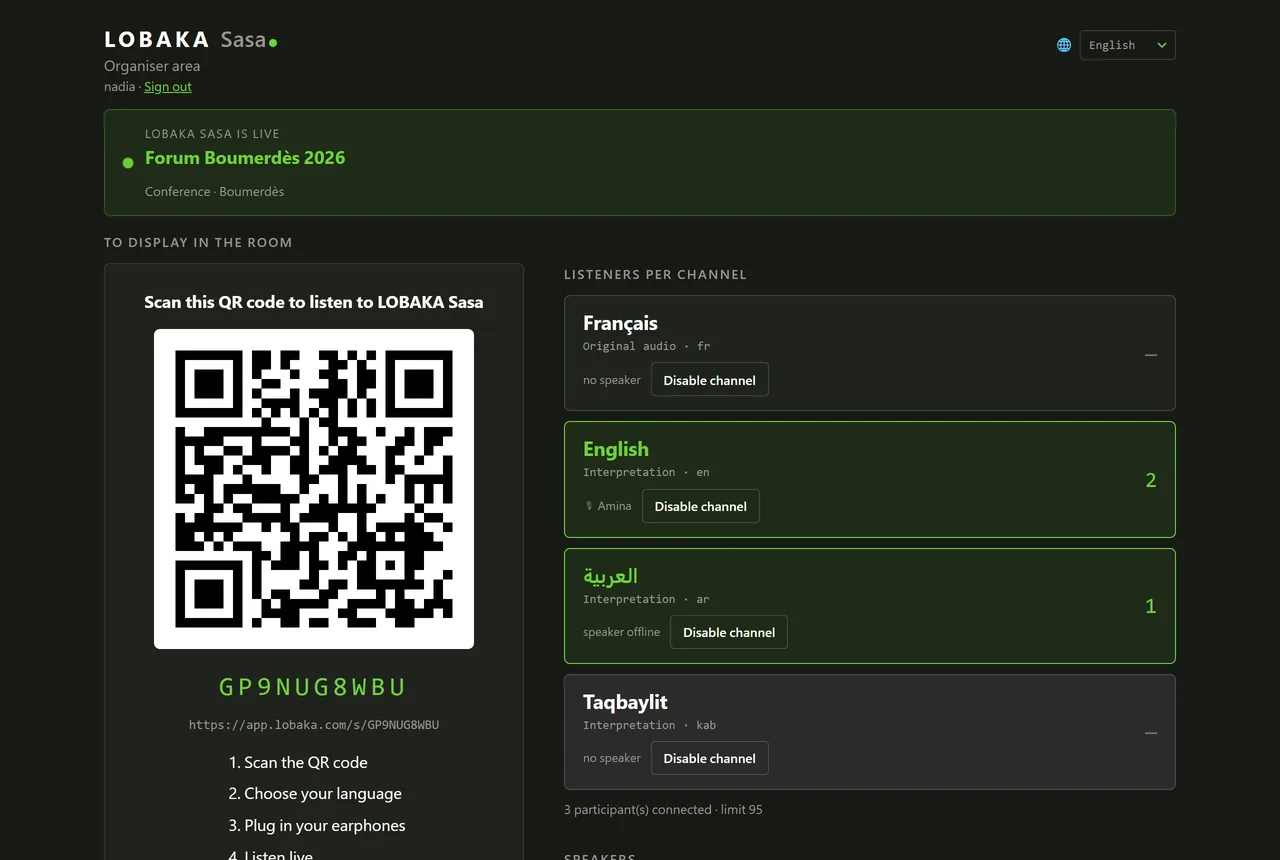
On a computer or tablet: the channels, the speakers and their status, the number of participants per channel, the QR code to project, the automatic end of the session and the button to extend it.
02

The speaker

Interpreter, commentator, guide, presenter — any voice broadcast on a channel.

What they do

  • Opens the link received from the organizer on their phone, no account needed.
  • Taps “Start broadcasting” and speaks: one voice at a time per channel, the floor is given and handed back.
  • Sees at any moment whether their voice is getting through and how many people are listening; can report a problem with one tap.

What they see

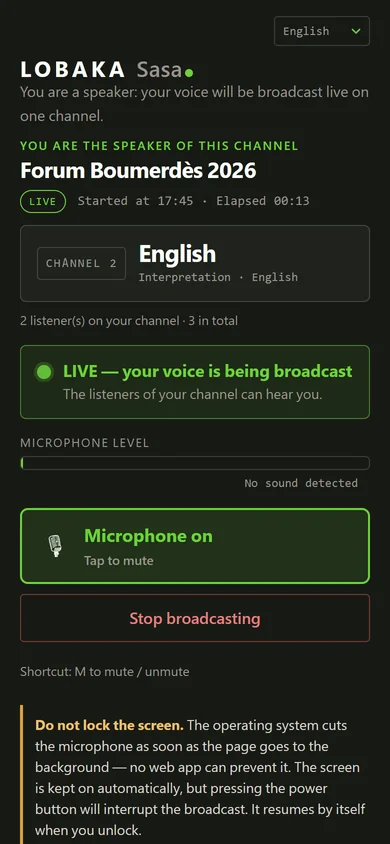
On their phone: their channel, the microphone, the sound level, the broadcast status, the number of listeners.

03

The participant

Every person in the audience, with their own phone.

What they do

  • Scans the QR code shown in the room — or types the session code.
  • Picks a channel from the list.
  • Listens through their earphones and switches channel whenever they like. At the end, an optional anonymous survey.

What they see

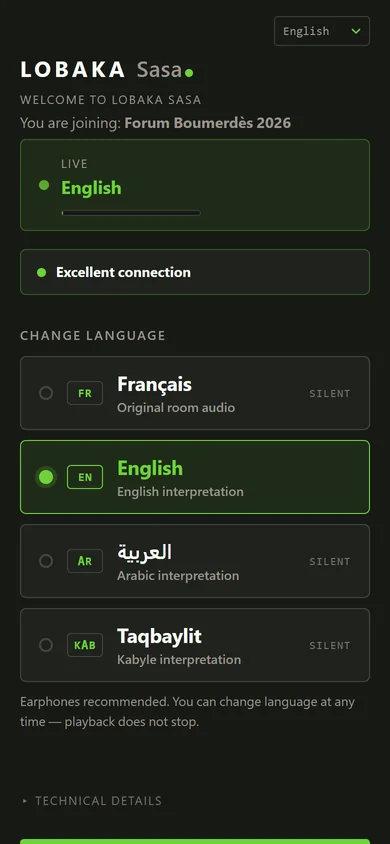
A simple page: the session name, the channels on offer, what they are listening to, and their connection status in plain words.

During the pilot phase, sessions are created on request: LOBAKA opens an organizer account, supports you through your first event, and the app clearly shows the limits of your access.

Screenshots

The product, screen by screen.

Screenshots taken on the LOBAKA Sasa application as it exists today, during a demonstration session.

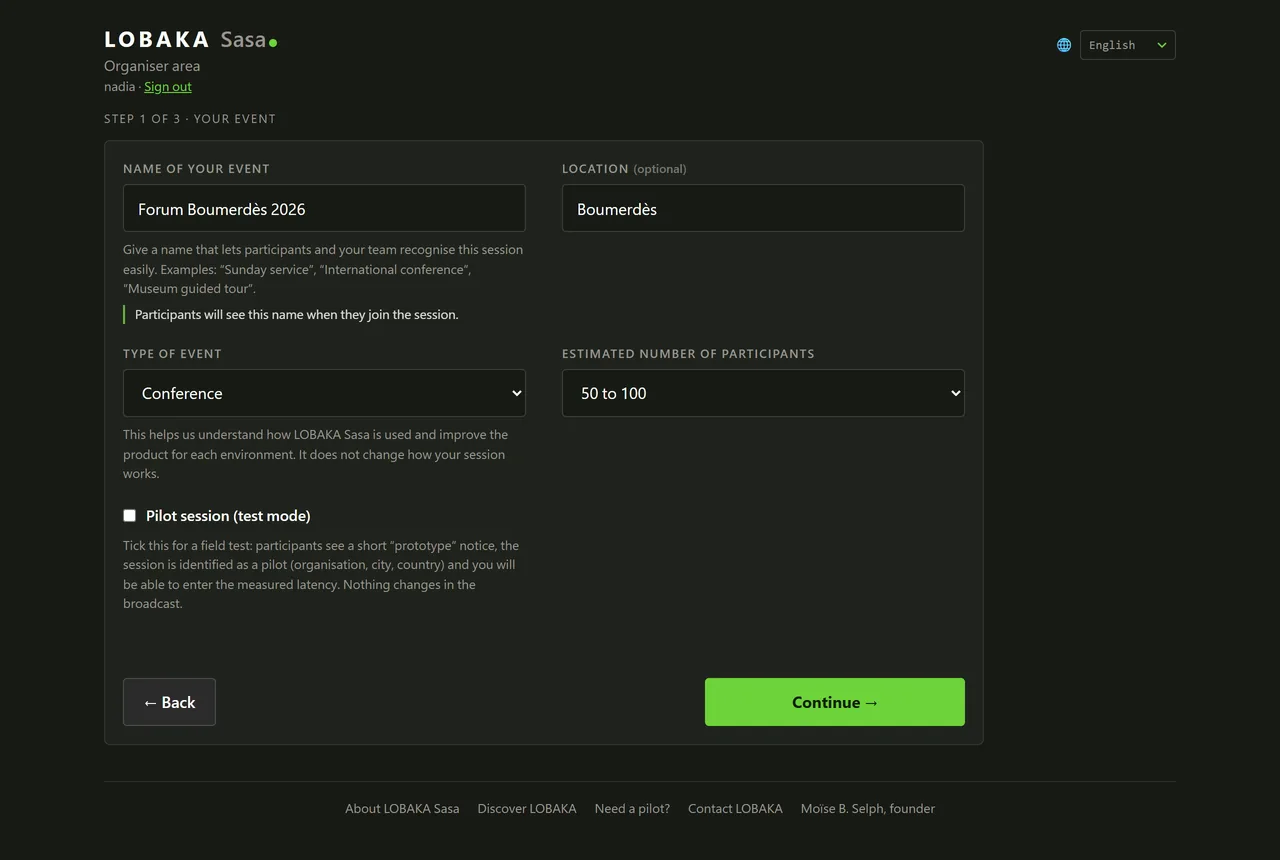
LOBAKA Sasa organizer area, step 1 of 3: the session creation form with event name, place, type and expected audience size.
OrganizerCreate a sessionA name, a place, an event type: the session is ready in a minute.
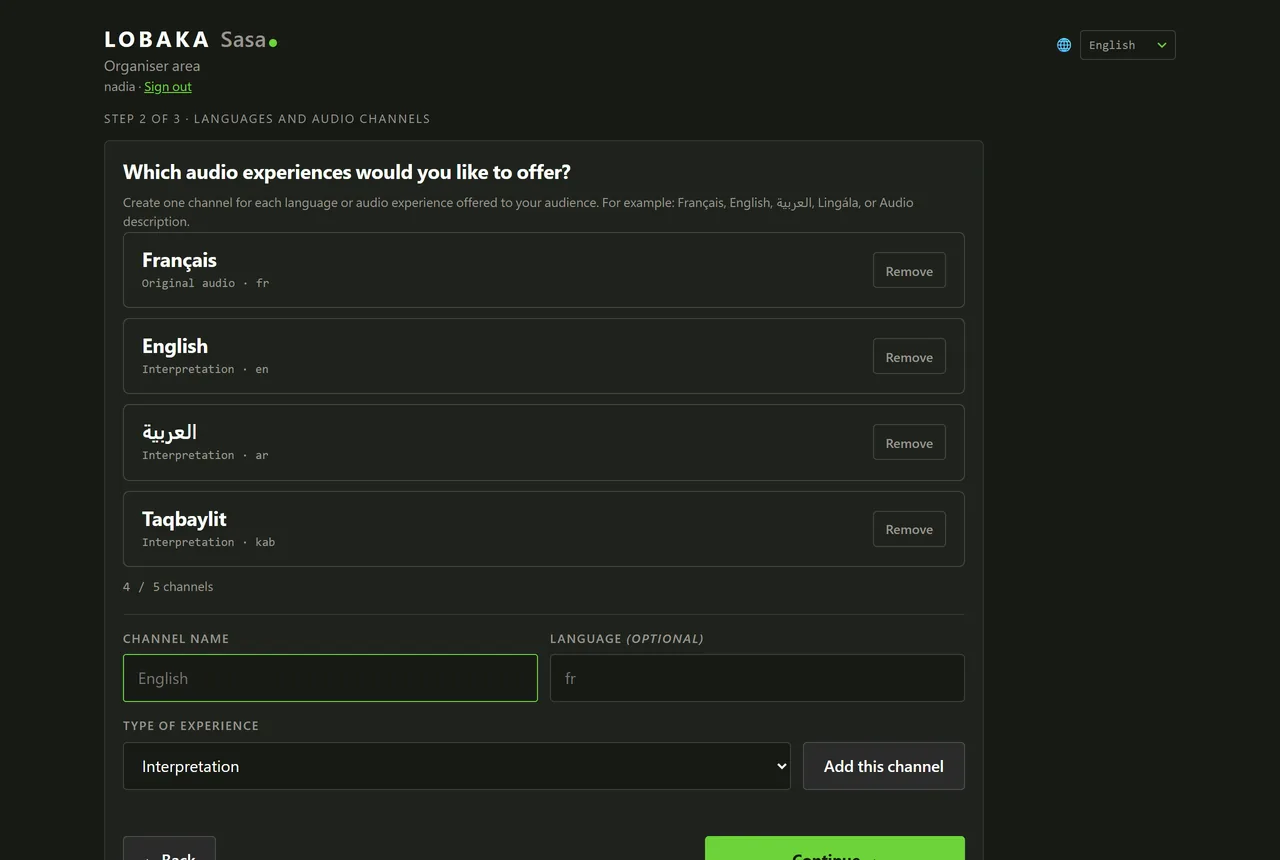
Organizer area, step 2 of 3: the list of audio channels created (Français, English, العربية, Taqbaylit) and the form to add a channel.
OrganizerSet up languages and channelsOne channel per language or experience: original audio, translation, commentary, audio description.
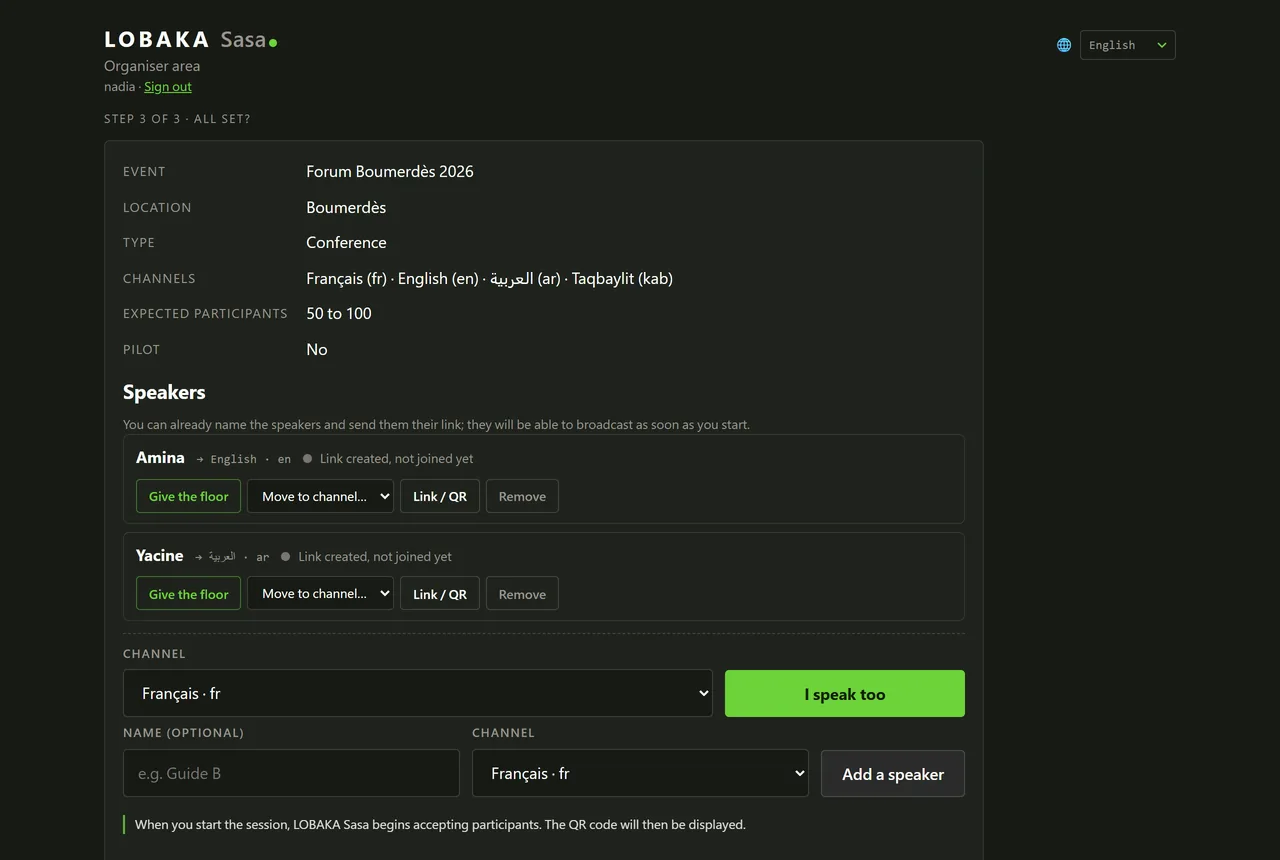
Organizer area, step 3 of 3: the session summary and the list of speakers with their channel, before starting.
OrganizerReview and invite the speakersThe summary before starting, and a personal link for each speaker.
Speaker dashboard on a phone: live session, English channel, “live — your voice is being broadcast” indicator, microphone level and a mute button.
SpeakerThe Speaker's interfaceOn their phone: the channel, the microphone, the sound level and the certainty that their voice is getting through.
Listener page on a phone: the English channel playing, the connection status and the list of available languages.
ListenerThe Listener's interfaceAfter scanning the QR code: the list of languages, one tap, and listening begins.
Organizer area during a live session: the QR code to project in the room, the number of listeners per channel and the active speaker on each channel.
OrganizerThe session in progressThe QR code to project, listeners per channel and the speakers on air, live.
Screen 1 of 6
Who it is for

Wherever a room doesn't speak a single language.

LOBAKA Sasa is an infrastructure, not a solution for one sector. The gesture is the same in a congress hall or a neighbourhood church.

International congresses and conferences

Several languages, interpreters, hundreds of participants with their phones.

Institutions and diplomacy

Ceremonies, meetings and receptions with foreign delegations.

Universities and training

Lectures, seminars and training courses followed by international audiences.

Tourism and guided tours

One guide, several languages, every visitor in their own earphones.

Museums and cultural venues

Multilingual audio guides with no devices to hand out or collect.

Shows, festivals, cinema

Original version, interpretation, commentary or audio description in the same room.

Places of worship and ceremonies

Services and family ceremonies followed in several languages, discreetly.

Companies, NGOs, assemblies

Meetings, assemblies and internal events where not everyone speaks the same language.

Why LOBAKA Sasa

Built for how multilingual rooms actually work.

01No app to install

The participant scans a QR code and opens a page in their browser. Nothing to download, nothing to set up.

02No account for participants

No sign-up, no password, no personal data asked in order to listen.

03The phone everyone already has

No proprietary receivers to buy, hand out, charge and collect at the end of the night.

04Several channels, one room

Interpretation, commentary, audio description or original sound: everyone chooses, and switches at any time.

05Simple for the organizer

A session takes minutes to prepare: the channels, one link per speaker, a QR code to project.

06Limits stated, never hidden

Ceilings enforced server-side (today 5 channels and 30 participants per channel): beyond them, access is refused cleanly, never degraded in silence.

Reliability, security, limits

What is guaranteed, what is measured, what isn't yet.

An organization that hands its room to LOBAKA Sasa must know exactly what it gets. Here is the real state of the product, as it runs today.

Encrypted from the browser to the server

Everything travels over HTTPS and encrypted WebRTC. The session code is random and unguessable; a speaker's link can be revoked at any moment.

No personal data to listen

The participant gives no name, no email, no phone number. The end-of-session survey is anonymous; leaving an email to stay informed is optional and requires explicit consent.

Ceilings enforced, not promised

Today: 5 channels per session, 30 participants per channel, 155 simultaneous participants per session. Beyond that, access is refused with a clear message. These ceilings evolve with the pilots.

A session lasts 4 hours, extendable

The session ends by itself at its deadline; the organizer extends it with one tap, up to 8 hours. Nothing stays open by oversight.

A monitored infrastructure

The server measures its own load and cleanly refuses new sessions before degrading the ones in progress. Incidents are logged and followed by LOBAKA.

What isn't measured yet

Mouth-to-ear latency in a real room. The measurement protocol exists; no figure is published until it has run with real phones and a real audience.

LOBAKA Sasa carries the voice; it does not replace interpreters, and does not replace an ISO booth where regulations require one. It brings multilingual audio where the classic set-up would never have been possible — and it can complement an existing installation.

Pricing

Free during the pilot phase. A simple model afterwards.

Pilot sessions are free and supported. The upcoming pricing model is based on duration, number of channels and number of participants — no imposed subscription. No price is published before it is real.

During the pilot phase, sessions are created on request: LOBAKA opens an organizer account, supports you through your first event, and the app clearly shows the limits of your access.

See pricing → · FAQ →

Field evidence

The proof will live here, room by room.

Results from the first LOBAKA Sasa pilot sessions will be published here: venue, audience size, channels and languages used, connection reliability, participant feedback. No pilot has been published yet; this space is reserved for real data, with the consent of the organizations involved.

Language should never be a barrier to participation.

Bring LOBAKA Sasa to your venue, or ask us your questions.